

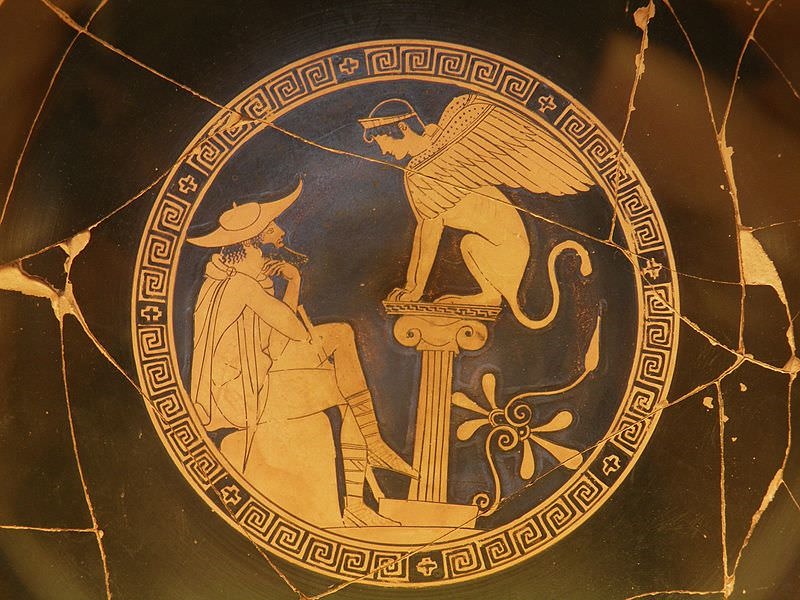

I have always loved mythology, especially Greek, and the riddle to be discussed was the one between King Oedipus and the Sphinx. Many people will know the Sphinx as the serene looking statue in Egypt near the Pyramids, but at the time of Oedipus, the Sphinx was a fierce creature half human/half lion which guarded the city of Thebes and would kill anyone who could not answer its riddle.
“Which creature walks on 4 legs in the morning, 2 legs at noon and ends the day on 3 legs?” was the riddle posed to Oedipus as he looked to enter the city. He correctly answered, “Humans” as the morning is the stage of life when infants are crawling on all fours, the noon is when they are now strong and walking on 2 legs, and the end of the day is the decline as they become elderly, the 3rd leg is the walking stick they need to move. The Sphinx died on this response, and Oedipus entered the city in triumph.
This riddle shows that walking sticks have been known since antiquity and displays human ingenuity in overcoming challenges. As technology progressed, the entire area of mobility aids has become a precise and important science to help with the challenges of mobility, providing walkers, Zimmer frames, rollators (and the list goes on), but this has to match with the challenges of human feelings and emotions.
On a professional level, one of my patients started to get problems with pain in her hips and knees. After investigation, it was clear she had severe osteoarthritis. When I discussed options for her, she was aghast, and when I asked why she looked so shocked, it was the simple fact that she did not consider herself “old”. She thought being told she had osteoarthritis was a slippery slope to senility!
I explained this was not the case and there were many things she could do to slow this process and adapt, and during this time, she could help her pain and mobility by using a walking aid. She was very reluctant to acknowledge this, but the next time I saw her, she came in with a beautiful walking cane topped by a silver handle, which aesthetically looked good but was not helping much with her pain and gait. I explained she could be referred for a walking aid assessment and she can take her walking cane with her to see if they could adapt this to her needs. Unfortunately, they were not able to, and the next time she came in, it was with a standard walking stick, which she acknowledged had helped her, but I could see it was more a case of “needs must” rather than what she wanted. This moment of acceptance can be quite traumatic, but our job as care providers is to try and help patients adapt to this new phase of their lives and maximise what they can do with the plethora of equipment and aids that are available for their needs.
Besides the personal acceptance of this, there is the challenge of the providers of these assessments and equipment being overwhelmed due to demand. Often, I have seen where patients refuse to use these aids until they suffer a significant injury and then will need these provided urgently, but waiting lists prevent this from happening. The charitable sector increasingly covers this gap due to the inadequately funded services, and I have signposted a number of my patients to charities like the British Red Cross who have some access to wheelchairs and other patients have ordered these, without a proper assessment, from Amazon or borrowed it from friends or relatives who have previously had crutches provided but not returned them. None of these scenarios is adequate or safe, as having a walking aid or any equipment, assessment ensures this is done properly.
Unfortunately, the parlous state of these services trying to tackle the challenges of our ageing population is a riddle which successive governments have failed to answer, and unless they do, they will be consumed by the Sphinx of their needs.
Original image by Carole Raddato. Uploaded by Mark Cartwright, published on 11 January 2017. The copyright holder has published this content under the following license: Creative Commons Attribution-ShareAlike. This license lets others remix, tweak, and build upon a work even for commercial reasons, as long as they credit the author and license their new creations under the identical terms. When republishing on the web a hyperlink back to the original content source URL must be included. Please note that content linked from this page may have different licensing terms.




.jpg)